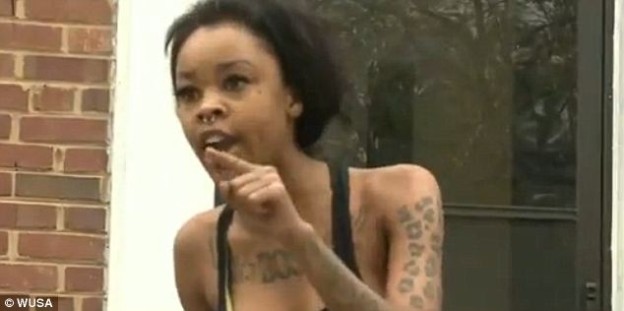
The incident was also captured by news crews from Channels 4 and 5, which aired it. The footage
soon found its way onto social media. The Washington Post also carried a clip.
But let’s rewind that tape. Should the story have aired at all?
Johnson says he doesn’t know the identity of the woman who attacked him or the circumstances that led her to the townhouse in which D.C. police said four armed men held eight people hostage and assaulted three of them. Neither does his boss, WUSA news director Fred D’Ambrosi.
Which leaves open the question: Was the woman one of the victims? Considering that most media organizations won’t identify survivors of violent crimes, out of concern for their privacy and safety, did TV crews cross a line in recording her and airing the footage?
There’s little question that the woman was the aggressor in the episode, or that Johnson was within his rights as a reporter. He noted Thursday that he was standing on public property outside the home when the woman, followed by two female companions, began yelling expletives at him to chase him from the scene. When he tried to calm her, she followed up with a punch that grazed Johnson’s head and struck WUSA camerawoman Danielle Gatewood-Gill on the arm.
D’Ambrosi and Johnson both said they discussed the implications of airing the incident, given that they knew little about the circumstances. But both agreed that it was newsworthy.
But another veteran TV news reporter, who spoke on the condition of anonymity because he is familiar with WUSA’s journalists, said: “This was a borderline call. I would want to know who the woman is before I aired it. You get driven by the pictures [in TV news]. The best video of the day is Bruce Johnson being attacked. But I don’t know if that’s the right call.”
What’s more, he points to another potential privacy issue: WUSA’s report clearly showed the street address of the home in question; news organizations typically shield victims by keeping the location of a crime general.
The story is complicated by the missing information about the woman’s identity and motives, said Mike Cavender, executive director of the Radio Television Digital News Association in Washington. But given what was known at the time, Cavender — a former news director at WUSA — says he would have aired the story.
“If we had the benefit of hindsight and we could look at the total continuum of events, given what she may have been through, you might ask yourself, ‘Do we need to use this?’ ” he said. “I would hope any reporter or producer would make a considered determination. But all you have to go on when you put the story together is what you know at the time. Based on what I saw and what I learned of the story, I would have gone with it.”
Commenters on WUSA’s Web site mostly defended the station and Johnson, or condemned the woman for her actions. But a few took the news media to task. Wrote one: “The news crew is in their rights, but was it really worth the drama? Couldn’t the news team have turned the camera off and left? Respect should have been given from both sides. The bigger person should have walked away before the news team became the news.”
On Thursday afternoon, Johnson said he was feeling fine. He said he had no plans to file charges against the still-unidentified woman.

No comments:
Post a Comment